The 10 square foot line
The EPA draws one clear line in its home guidance. If the moldy area is less than about 10 square feet, which is a patch of roughly 3 feet by 3 feet, many homeowners can clean it themselves. Above that, or after a lot of water damage, it points to its remediation guidance and advises hiring a contractor with mold experience.
| Situation | Usual handling | Reason |
|---|---|---|
| Under about 10 sq ft, firm painted drywall, leak already fixed | Homeowner cleanup with protection | Small area, hard surface, source is gone |
| Over about 10 sq ft | Professional assessment | More material is affected and spread is harder to control |
| Soft, sagging or stained-through ceiling | Professional removal | The material holds water and may need to be cut out |
| Textured or ceiling tile surface | Professional, in most cases | Porous surfaces are hard to clean in place |
| Smell with nothing visible | Professional inspection | The EPA says to suspect hidden mold |
Protect yourself and the room first
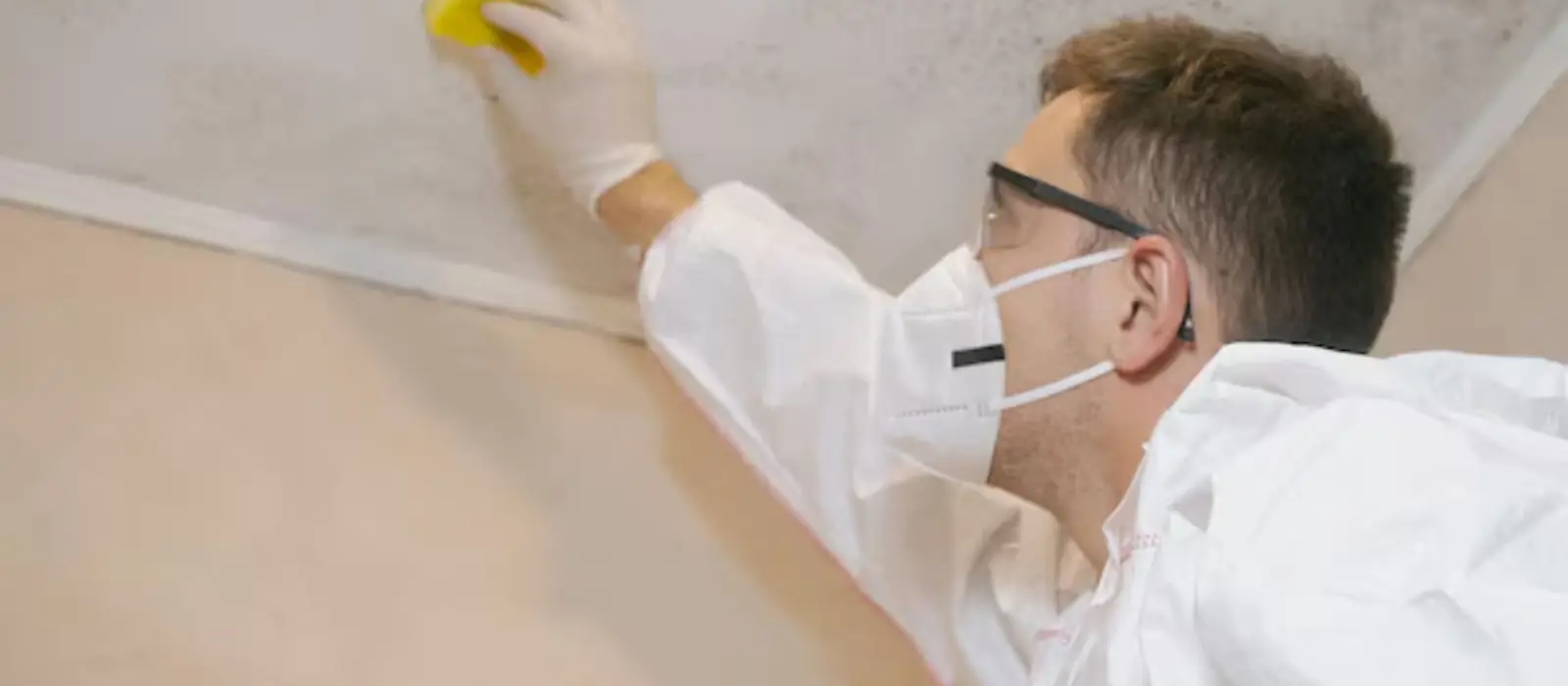
Cleaning disturbs growth and sends material into the air. The EPA lists an N-95 respirator, long gloves that reach the middle of the forearm, and vent-free goggles as protective gear. Questions about whether you should do the work at all, given your own health, belong with your physician.
- Confirm the water source is repaired and the area is dry. Cleaning a ceiling that is still getting wet is wasted time.
- Put on the respirator, gloves and goggles before you disturb anything.
- Cover the floor and furniture with plastic sheeting and tape it down.
- Keep other people and pets out of the room while you work.
- Bag the used rags and any removed material, seal the bag, and take it out of the house.
What a small cleanup actually involves
For a firm, painted surface, the EPA recommends scrubbing mold off hard surfaces with detergent and water, then drying completely. Work with a damp cloth, not a soaking one, since drywall absorbs water. A fan pointed at the ceiling after cleaning helps the surface dry.
Porous materials are a different story. Ceiling tiles and carpet that turn moldy may have to be thrown away, according to the EPA, so a tile that has gone soft or stained through is not a cleaning job.
Skip the bleach bottle. The EPA does not recommend it for routine cleanup, and it specifically warns against combining chlorine bleach with ammonia cleaners. A cloth, detergent, water and patience are the whole kit.
Why painting over mold fails
The EPA is blunt here. Do not paint or caulk moldy surfaces, because paint applied over mold is likely to peel. Fresh paint also hides the stain, so the warning sign disappears while the cause stays.
If the stain returns under new paint, the moisture was never solved. That points back to a leak or a ventilation problem, not a paint problem.
Textured and popcorn ceilings
Texture catches growth in its peaks and holds moisture longer than a flat surface. Scrubbing tends to pull texture loose and spread debris, so a small cleanup can turn into a larger one. If growth covers a textured ceiling, a professional can contain the room and remove the affected layer under controlled conditions.
After the leak is fixed
The EPA's timing is worth keeping on the fridge. Wet areas and items should be dry inside 24 to 48 hours, or growth can start. If your ceiling stayed wet longer than that, treat it with more caution.
Even after a good cleanup, total elimination is not realistic indoors, because some spores are always in the air and house dust. They need moisture to grow, so the long-term plan is control. Aim for relative humidity under 60 percent, with 30 to 50 percent as the ideal range.
Watch the ceiling for the next several weeks and photograph it from the same spot each time. A dated record makes it obvious whether a faint mark is fading, holding or growing, and it helps if an insurer or a buyer ever asks.
When a pro is needed, the scope runs from drying under water mitigation through cleanup under mold remediation and into rebuilding. The price depends on area, materials, drying days and rebuild scope, so the real number comes from a scoped inspection.
Mashpee note: S520, the EPA line, and old Cape buildings
S520, from ANSI and the IICRC, is the written standard that sets out how mold remediation should be run. Put the question to a contractor directly, and ask how crews handle containment and drying. We make no certification claim here. The standard exists, and a straight answer is reasonable to expect.
The EPA's 10 square foot guideline is the practical dividing line on the Cape too. A small patch in a rental cottage bathroom is a different job from a ceiling that has been damp since the last storm.
Mashpee's Old Indian Meeting House dates to 1684, so buildings in town have stood in damp coastal air for a very long time. That does not mean your ceiling is old, but it is a reminder that moisture control is part of owning a Cape home.
In the Cotuit Historic District, most of about 125 properties date to roughly 1850 to 1920, so a bathroom there may have been added later and its fan duct may run a long way. In Osterville, summer crowds mean many houses sit lightly used in cold months, and a slow ceiling leak can go unseen for weeks.
Water or mold in your home right now? Call the 24/7 line: (508) 446-9244
Questions Mashpee Homeowners Ask
Can I clean ceiling mold with bleach?
Not as a habit. The EPA advises against bleach as part of routine cleanup, and the mixing hazard is real, since chlorine bleach and ammonia products must never be combined. For a firm surface, wash with detergent and water and let it dry fully.
Why does mold come back after I paint?
Because paint does not remove growth or fix moisture. The EPA says not to paint or caulk moldy surfaces and notes that paint over mold is likely to peel. A returning stain means water is still present.
What protective gear does the EPA list for mold cleanup?
The EPA names an N-95 respirator, long gloves that reach mid-forearm, and goggles with no ventilation holes. Anyone with health concerns should talk to a physician before doing the work.
Is a mold test needed before cleaning?
Usually not. When growth is plainly visible, the EPA sees little need to sample, and it points out that no federal limits for mold or spores exist to compare a result against. Testing has a role in some situations, such as a sale, but it is not step one.
What is the Old Indian Meeting House and why is it mentioned?
It is a Mashpee landmark built in 1684. It appears here only as a reminder that Cape buildings have long dealt with damp coastal air. It is not a claim about any specific house or about how your ceiling will behave.